
Your website is already a product video
The headline, the product and the proof are already on your homepage. Most product videos start from a blank page anyway. Why that’s backwards.
Sep 26, 2026
Much of a video’s value reaches people who stop watching within seconds. What a product video’s opening must do, and why logo intros cost so much.

In 2015, Facebook and Nielsen looked at 173 brand studies of video ad campaigns and asked where the value came from. The answer was uncomfortable for anyone who makes videos. People who watched less than three seconds of an ad created up to 47% of the total campaign value. People who watched less than ten seconds created up to 74%. [1]
Read that again from the other side. A large share of what a video accomplishes, sometimes most of it, comes from people who never see most of the video. The part that nearly everyone watches is the beginning. The part most people never reach is everything else.
YouTube built a whole ad format around the same fact. A skippable ad can be skipped after five seconds, and a bumper ad lasts five to six seconds in total. [2] The people who design those formats have more data about attention than anyone, and they decided the first few seconds were the unit worth selling.
If most viewers only see the opening, the opening has to contain the message. Everything after it is for the people who were convinced enough to stay.
In the first few seconds, a viewer should learn two things, in this order:
Whose video this is. In a feed, your video appears between a friend’s holiday and a news story, so the viewer has no idea who’s talking. A brand mark answers that.
What the product promises. Not the whole pitch. The one sentence that makes someone want the next one.
Everything else, including which features you have, how it works and who uses it, is for the people who stay. That’s the real job of the opening: to decide who stays.
A lot of product videos open with a logo animation. The mark draws itself, spins, glows, and settles, and three to five seconds later the video begins.
On the numbers above, those are the most expensive seconds in the film, and they carry the least information. A logo tells the viewer who. It doesn’t tell them why they should care, and why is what keeps them watching.
The fix isn’t necessarily to cut the logo. In a feed, “who” matters, and a viewer who doesn’t know whose video they’re watching can’t connect it to anything. The fix is to keep the mark short and let the promise arrive right behind it. Give the brand a beat or two, then put the headline on screen while the viewer is still deciding.
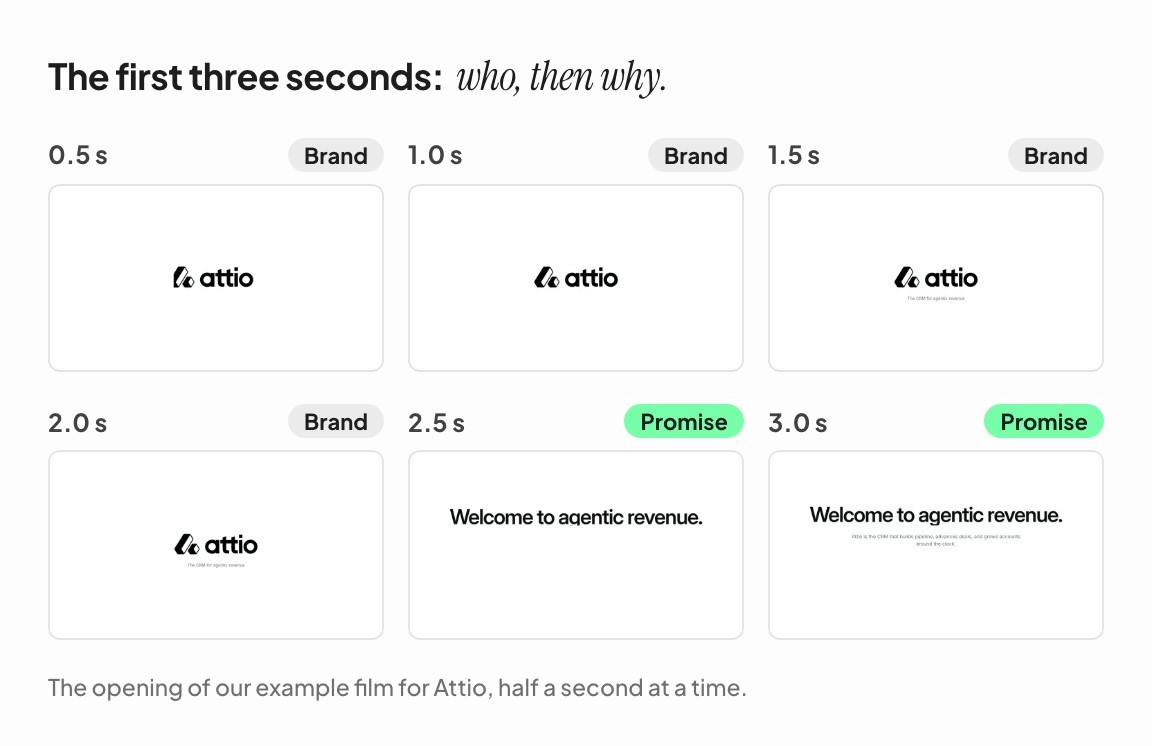
On your own homepage the balance tips further. The visitor already knows whose site they’re on; the URL and the navigation told them. A homepage video can afford even less time on the logo, and should get to the product faster.
The best opening line for a product video is usually already written: it’s your homepage headline. It’s the sentence your company has argued over longest, and it was written for exactly this moment, a stranger deciding in a few seconds whether you’re worth their time. (Your website is already a product video makes the longer case.)
The best opening picture is your product doing the thing the headline promises, framed large enough to read on a phone. A headline over an abstract gradient asks the viewer to take your word for it. A headline over the product at work gives them a reason to.
The first frame of a homepage video matters even before the video plays. Until the file loads, the visitor sees the poster image, and on a slow connection that can be a while. If the poster is a black frame, the first thing your homepage shows is a black rectangle.
So choose the opening, or the poster, as if it were a still ad. A frame with your headline and a glimpse of the product works as a poster and as a first second. A frame caught halfway through a transition works as neither.
Open your product video. Pause it at three seconds and take a screenshot. Then pause it at five, the moment YouTube lets people skip, and take another.
Show the first screenshot to someone who has never heard of your company and ask whose video it is. Show the second and ask what the product does.
If they can answer both, your opening works. If the five-second frame is still a logo, a fade from black or a transition caught in the middle, a large share of your viewers will leave before your video says anything at all. The good news is that the opening is the easiest part of a video to fix, and the part worth the most.
Facebook for Business news post, March 17, 2015: “people who watched under three seconds of the video ad created up to 47 percent of the total campaign value, and people who watched for fewer than 10 seconds created up to 74 percent, depending on the metric.” Based on 173 Nielsen BrandEffect studies. Archived copy
Google Ads Help, “About video ad formats”: “After 5 seconds, the viewer has an option to skip the ad”; bumper ads are “non-skippable video ads lasting between 5 and 6 seconds.” support.google.com

