
How long should a product video be?
Thirty to sixty seconds on your homepage, under fifteen in a feed, a few minutes for a demo. Where those numbers come from, and how to find your own.
Sep 26, 2026
The headline, the product and the proof are already on your homepage. Most product videos start from a blank page anyway. Why that’s backwards.

Most companies make a product video the same way. Someone writes a brief. An agency reads it and sends back a script. The script goes through a few drafts, then becomes a storyboard, then style frames, then animation, then a couple of rounds of changes. Six weeks later there is a video that explains the product in words nobody at the company wrote.
The strange thing about this process is where it starts. It starts from nothing, as if the company had never tried to explain itself before. But every software company already has a document that explains the product to strangers in a few seconds. It has been rewritten more times than anyone remembers, and most customers read it before they buy. It’s the homepage.
Think about how your homepage headline got written. Probably a founder wrote the first version. It changed after the first ten sales calls, when you noticed which words made people lean in. It changed again when you found your real market, or raised money, or lost an argument with your head of marketing. If you ran tests, it survived those too.
That sentence has had more drafts, more readers and more contact with actual customers than any script an agency will write in a two-week window. The same goes for your subheadings, your feature names, your customer count and the text on your main button. Each one is compressed from months of conversations.
A script written from a brief throws all of that away and starts over. The result is usually worse, and not because the writer is bad. The writer had two weeks and a PDF. You had years, and your customers.
A software company has something most companies don’t: a product people can look at. A law firm can’t film the law. A bank can’t film interest. You can put the actual thing on screen.
People evaluating software want to see the actual thing. They want to know what they’ll be looking at every day if they buy. An illustration of floating cubes asks them to translate a metaphor back into a product. A shot of your product doesn’t ask them to do anything.
Real interface is also a kind of proof. An illustrated dashboard could be anything, including something that doesn’t exist yet. Your real dashboard, with your real labels and your real data model, is evidence that you’ve built what you say you’ve built.
Most homepages carry some proof: a customer count, a row of logos, a number that matters in your category. These are claims you’ve already decided you can stand behind in public. A video can use them without anyone going back to legal.
There’s a less obvious reason to use your own words. A product video almost never appears alone. It sits at the top of your homepage, or in a post that links to your homepage, or in an ad that sends people to a landing page. Wherever it runs, the viewer will be reading your page a few seconds later.
If the video says what the page says, each makes the other more convincing. The visitor meets the claim twice, in two forms, and the second time it already feels familiar. If the video invents a new tagline, the visitor now has two claims to reconcile, and a small doubt about which one is the real one. Landing page people have a name for this: message match. [1]
I suspect the process was inherited. Video production grew up making commercials, and for most of the history of commercials, the ad was where a company’s message got written. There was no homepage to borrow from. The brief, the script and the storyboard exist to invent a message, because for a long time there wasn’t one yet.
A software company that wants a product video is in the opposite position. By the time it’s ready to spend money on video, it has usually spent years writing and rewriting the page the video will sit on. Running the old process anyway means paying someone to invent a message you already have, and then paying again to reconcile the two.
If the words, the product and the proof already exist, what’s left to do? Quite a lot, actually. It’s just a different kind of work.
The first job is choosing. A homepage can easily make twenty or thirty claims. A 30 to 60 second video has room for about six lines of text, around forty words. So the real work is deciding which six, in what order, and which piece of the product to show under each one. That’s editing, and it’s harder than writing, because every line you cut was put on the page by someone who thought it mattered. (How many words fit in a 30-second video goes through the numbers.)
The second job is composition. A product interface is designed to be used at arm’s length on a laptop. In a video it might be seen at the width of a phone. So each piece of interface has to be framed at a size someone can read in a second and a half, which usually means showing one card, one chart or one row instead of the whole screen.
The third job is timing. The first time most people see your video, it will be on mute, because browsers won’t autoplay sound. So the video needs a rhythm that does the job a narrator’s voice would have done, with every cut and every line landing on a beat. (Design your product video for sound off explains how.)
The fourth job is shape. The same video has to work at 16:9 on your homepage, 9:16 in a story and 1:1 in a feed, and each of those is its own layout. (Why you can’t just crop a 16:9 video to 9:16 shows why.)
None of this involves inventing anything. All of it is craft.
Here’s a quick way to see how much of your video already exists.
Open your homepage and copy the headline.
Find the one piece of your product that shows the headline being true.
Find the one number or customer name that proves it.
Copy the text on your main button.
That’s four shots. Put your logo at the start and the end and you have most of a film.
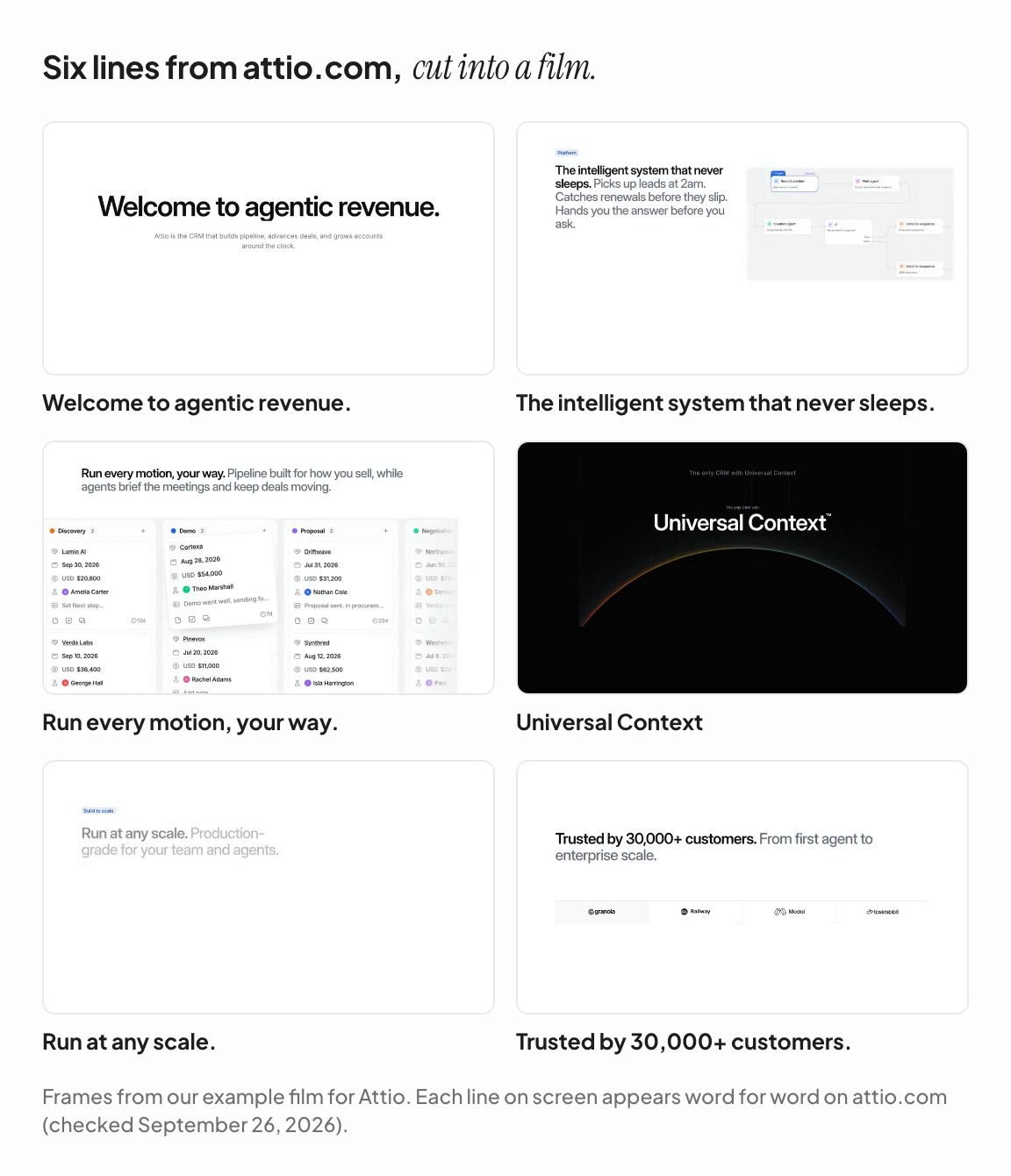
We checked this against our example film for Attio, which we made from their public homepage (Attio didn’t commission it). Every line on screen, from “Welcome to agentic revenue.” to “Trusted by 30,000+ customers.”, appears word for word on attio.com. [2]
Starting from your website changes the economics of a product video. There’s no script to approve, because the words were approved when you published them. There’s no visual style to invent, because your product and your brand already have one. And there’s far less to argue about, because everything on screen is something you already say in public.
It also changes what the video is. A video built from your homepage is your homepage, compressed into the half minute before a visitor decides whether to keep reading.
That’s the idea VideoFold is built on. Your website already contains the film. Someone just has to cut it.
Unbounce defines message match as “a measure of how well your landing page copy matches the phrasing of the ad or link that brought the visitor there,” and says strong message match increases conversions because it reassures people they’ve come to the right place. Unbounce conversion glossary
We compared each on-screen line of the Attio example film with the live attio.com homepage on September 26, 2026. All six headlines appeared verbatim. Homepages change, so a line sheet should always carry the date it was checked.

