
Your website is already a product video
The headline, the product and the proof are already on your homepage. Most product videos start from a blank page anyway. Why that’s backwards.
Sep 26, 2026
Studios quote five to twelve weeks for a one-minute explainer. Their own published timelines show where the weeks go, and why most go to inventing.

Ask a video studio how long a one-minute explainer takes and you’ll get a number between five and twelve weeks. Studios aren’t slow. The process has a shape, and the shape takes that long.
It’s worth looking at that shape closely, because most of it exists to invent things a software company already has.
You don’t have to guess at the timeline. Studios publish it.
Studio | Stated timeline for an explainer |
|---|---|
Wyzowl | About 6 weeks, kick-off to delivery [1] |
Epipheo | 6 to 8 weeks for a single video [2] |
Yum Yum Videos | 7 to 9 weeks, beginning to delivery [3] |
Demo Duck | 8 to 10 weeks of production, 10 to 12 weeks all in [4] |
Breadnbeyond | About 25 working days for 60 to 90 seconds [5] |
Surveys land in the same place. When Yum Yum Videos asked 61 studios to quote the same 60-second animated explainer in 2026, the median estimated timeline was seven weeks. [3] An older Wyzowl survey of studios put the average turnaround at 38.5 days. [6]
So “six weeks” is roughly the industry’s answer, give or take a month.
The studios also publish the stages, and they’re nearly identical from one studio to the next. Epipheo’s plan for a 60-second explainer is typical: discovery in week one, script in weeks two and three, storyboard in weeks three and four, animation in weeks four to seven, delivery in week eight. [2]
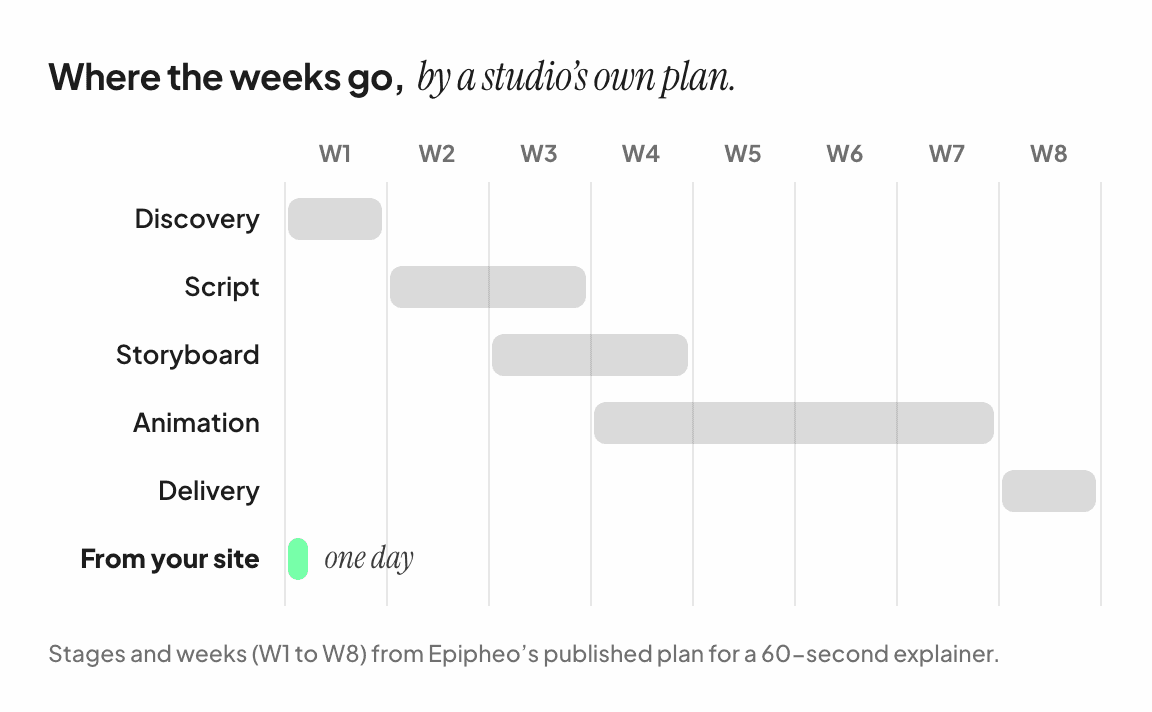
Yum Yum lists the working time for each stage: a day of research and kick-off, two to three days of script, about a week of storyboard, a day of voice-over, two to three days of style frames, about a week of illustration, about a week of animation, a day or two of music and sound. Then it adds a sentence worth quoting in full: “Those are production times, not the entire calendar.” Client reviews alone, it says, add at least eight days. [7]
Two things stand out.
The first is that the stages run in series. Epipheo’s note on the storyboard stage says it plainly: “Nothing animates until this is signed.” [2] Every stage waits for the one before it to be approved, so the calendar is the sum of all the work plus all the waiting, and adding more animators doesn’t shorten the waiting.
The second is what the stages are for. Look at the list again: a script, a storyboard, style frames, illustrations, a voice-over. Each is an invented thing. The script is a new set of words. The storyboard is a new set of pictures. The style frames are a new look. Each one needs to be reviewed and approved, because nobody at the client has seen it before.
Every studio builds in review rounds, and every studio warns about them. Demo Duck says the most variable part of its timeline is how long the client’s team takes to review and give feedback. [4] Epipheo says each additional revision round adds roughly 8 to 12% to the invoice and about a week to the calendar. [2] Breadnbeyond says redoing approved creative is the biggest cause of delayed schedules. [5]
This is what you’d expect from a process built on invention. When the words are new, the founder rewrites them. When the look is new, marketing asks for another option. When the voice-over is new, someone decides the pacing is off. None of these are unreasonable requests. They’re the natural result of seeing something for the first time.
Price follows the same shape, because price is mostly people’s time across all those stages. Published prices for a one-minute explainer run from about $2,700 at Wyzowl to $20,000 to $25,000 for Demo Duck’s higher-end work, with Epipheo quoting $15,000 to $45,000. [1] [4] [2] The two studio surveys put the median at $5,400 (Wyzowl, 2022 data) and $9,680 (Yum Yum, 2026). [6] [3]
If most of the calendar is spent inventing things and then approving them, the way to shorten it is to invent less.
A software company that wants a product video already has most of what those stages produce:
The script exists. It’s the copy on your homepage and product pages, already written, tested and approved. Use it word for word and there’s no script stage and no script revisions. (How to write a product video script from your own website shows the method.)
The visuals exist. Your product is the thing people want to see, and it already has a design. There’s no need for illustration or style frames when the real interface is on screen.
The look exists. Your brand has colours, type and a logo. A video that uses them doesn’t need a round of style exploration.
The voice-over can go. The first time most people see your video it will be on mute anyway, because browsers won’t autoplay sound. (Design your product video for sound off explains why that’s a feature.)
What’s left is the part that was always the real work: choosing which lines to use, which piece of the product to show under each one, in what order, on what rhythm, and in which shapes. That’s editing. It still takes skill, but it doesn’t take six weeks, because almost nothing in it needs to be approved for the first time.
That’s how VideoFold delivers a product video in 24 hours. We don’t animate faster. We skip the stages that exist to invent what your website already says.
Wyzowl, explainer videos: “A typical animated explainer video takes around 6 weeks from kick-off to final delivery.” Pricing “starts from £2,000 ($2,700).”
Epipheo, premium explainer video and explainer video cost, including the week-by-week plan and the note on revision rounds.
Yum Yum Videos, FAQ (“most projects take between seven to nine weeks”) and explainer video cost survey (61 usable quotes, median $9,680, median estimated timeline 7 weeks).
Demo Duck, explainer video production, animation process and explainer video cost.
Breadnbeyond, video production cost and FAQ.
Wyzowl, explainer video cost survey (Q4 2022 data: median $5,400). The 38.5-day average turnaround is from Wyzowl’s 2018 edition of the survey (archived).
Yum Yum Videos, explainer video production process (May 19, 2026).

